ELEMENTS OF DIRECTING
1. MOTIVATION
2. COMMUNICATION
3. LEADERSHIP
4, SUPERVISION
MOTIVATION

The word motivation is derived from the latin word movere which means to move.it means inducement to act in a desired way.
"motivation means a process of stimulating people to action to accomplish desired goal"
William G Scout
MOTIVATION PROCESS

THEORY OF MOTIVATION
Famous psychologist ABRAHAM HAROLD MASLOW developed a conceptual framework for understanding and explaining the nature of human needs .
He suggest two major things about human needs;

1https://youtu.be/uNaDKER1G-kG-k
COMMUNICATION
Communication is simply the act of transferring information from one place, person or group to another.
Every communication involves (at least) one sender, a message and a recipient. This may sound simple, but communication is actually a very complex subject.
Categories of Communication
There are a wide range of ways in which we communicate and more than one may be occurring at any given time.
The different categories of communication include:
Spoken or Verbal Communication, which includes face-to-face, telephone, radio or television and other media.
Non-Verbal Communication, covering body language, gestures, how we dress or act, where we stand, and even our scent. There are many subtle ways that we communicate (perhaps even unintentionally) with others. For example, the tone of voice can give clues to mood or emotional state, whilst hand signals or gestures can add to a spoken message.
Written Communication: which includes letters, e-mails, social media, books, magazines, the Internet and other media. Until recent times, a relatively small number of writers and publishers were very powerful when it came to communicating the written word. Today, we can all write and publish our ideas online, which has led to an explosion of information and communication possibilities.
Visualizations: graphs and charts, maps, logos and other visualizations can all communicate messages.

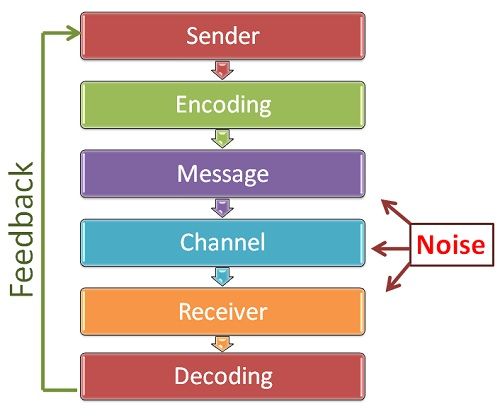
The communication is a dynamic process that begins with the conceptualizing of ideas by the sender who then transmits the message through a channel to the receiver, who in turn gives the feedback in the form of some message or signal within the given time frame. Thus, there are Seven major elements of communication process:

- Sender: The sender or the communicator is the person who initiates the conversation and has conceptualized the idea that he intends to convey it to others.
- Encoding: The sender begins with the encoding process wherein he uses certain words or non-verbal methods such as symbols, signs, body gestures, etc. to translate the information into a message. The sender’s knowledge, skills, perception, background, competencies, etc. has a great impact on the success of the message.
- Message: Once the encoding is finished, the sender gets the message that he intends to convey. The message can be written, oral, symbolic or non-verbal such as body gestures, silence, sighs, sounds, etc. or any other signal that triggers the response of a receiver.
- Communication Channel: The Sender chooses the medium through which he wants to convey his message to the recipient. It must be selected carefully in order to make the message effective and correctly interpreted by the recipient. The choice of medium depends on the interpersonal relationships between the sender and the receiver and also on the urgency of the message being sent. Oral, virtual, written, sound, gesture, etc. are some of the commonly used communication mediums.
- Receiver: The receiver is the person for whom the message is intended or targeted. He tries to comprehend it in the best possible manner such that the communication objective is attained. The degree to which the receiver decodes the message depends on his knowledge of the subject matter, experience, trust and relationship with the sender.
- Decoding: Here, the receiver interprets the sender’s message and tries to understand it in the best possible manner. An effective communication occurs only if the receiver understands the message in exactly the same way as it was intended by the sender.
- Feedback: The Feedback is the final step of the process that ensures the receiver has received the message and interpreted it correctly as it was intended by the sender. It increases the effectiveness of the communication as it permits the sender to know the efficacy of his message. The response of the receiver can be verbal or non-verbal.
Comments
Post a Comment